Gold Approaches a Critical Test: Breakout or Pullback Beyond 4,700?


Gold has regained upward momentum, supported by falling long-term US Treasury yields and renewed concerns over the expanding US fiscal deficit and sovereign debt outlook.
But the stronger gold becomes, the more important the next move gets.
After climbing to around 4,673, gold pulled back sharply and closed near 4,599, signalling that selling pressure is beginning to emerge at elevated levels. Technical momentum remains constructive, but with the RSI approaching overbought territory and resistance building around 4,700–4,740, the market is entering an increasingly important decision zone.
The question now is whether this is simply a pause within a broader uptrend—or the beginning of a deeper consolidation.
Why Falling Treasury Yields Are Supporting Gold
The recent decline in long-term US Treasury yields has been an important driver behind gold’s recovery.
At the same time, investors are reassessing the longer-term implications of widening US fiscal deficits and expanding government debt. Against this backdrop, some capital has increasingly turned toward gold as a non-sovereign asset and potential hedge against fiscal and debt-related uncertainty.
However, the reason behind falling yields matters.
If yields are declining primarily because investors are becoming more concerned about the economic outlook and moving into Treasuries, while the Federal Reserve remains reluctant to ease policy, gold may not benefit indefinitely.
This makes the next round of Federal Reserve communication particularly important.
Fed Signals Could Become the Next Catalyst
Attention is turning to Jackson Hole, where comments from Fed Chair Kevin Warsh could quickly reshape expectations around the US dollar and real interest rates.
A more hawkish message—particularly one emphasising persistent inflation risks and the need to keep interest rates higher for longer—could revive demand for the US dollar and put upward pressure on yields.
That would create a more challenging environment for gold. After the recent rally, crowded long positioning could also make the market vulnerable to a faster wave of profit-taking.
A more dovish signal would create a different scenario.
If markets begin pricing a lower future path for interest rates, Treasury yields and the dollar could remain under pressure. That would give gold an opportunity to challenge its recent highs and potentially extend the broader advance.
The policy message matters, but the market reaction in the dollar and real yields may ultimately provide the clearer signal for gold.
The Longer-Term Gold Story Remains Intact—but Risks Are Building
Short-term changes in monetary policy expectations have not removed several of the longer-term factors supporting gold.
Continued central-bank purchases, rising US fiscal pressure and growing investor attention to sovereign debt risk are reinforcing gold’s role as a non-sovereign asset within global portfolios.
The relationship between the US dollar, real interest rates and fiscal risk has therefore become increasingly important.
When the dollar weakens, real yields fall and fiscal concerns intensify at the same time, the environment can become particularly supportive for gold.
But a market trading near elevated levels also carries vulnerabilities.
As prices rise, financial flows and speculative positioning can play a larger role in price discovery. A reversal in rate expectations accompanied by simultaneous increases in the dollar and real yields could therefore trigger rapid long-position unwinding and amplify volatility.
Physical demand also remains important. Persistently high gold prices can weaken jewellery consumption and purchasing appetite in price-sensitive markets.
For the rally to remain sustainable, the market will need sufficient demand from a combination of investment flows, central-bank purchases and end consumers to absorb supply as prices move higher.
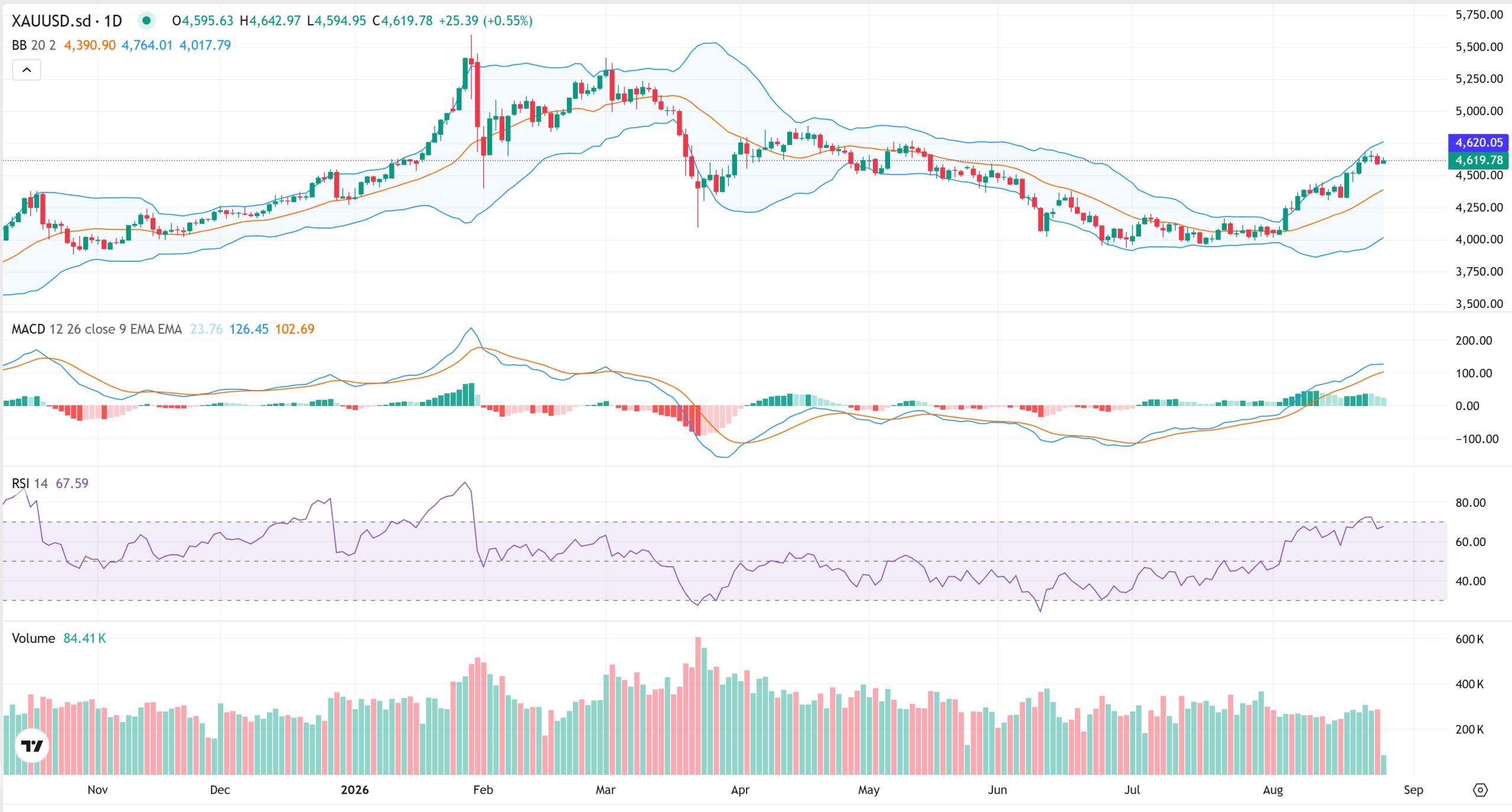
Technical Outlook: Bulls Remain in Control, but 4,700–4,740 Is the Test
From a daily-chart perspective, gold has continued to recover since stabilising around its July lows, with the pace of the advance accelerating during August.
Price has moved back above the 9-day moving average and toward the upper Bollinger Band, marking a transition from the previous lower-level consolidation into a stronger upward structure.
That bullish structure remains intact.
However, the latest rejection deserves attention.
Gold climbed to approximately 4,673 before retreating sharply and closing around 4,599, indicating that selling pressure is becoming more noticeable as the market approaches the 4,700–4,740 resistance zone.
If buyers can absorb this short-term selling pressure and push price decisively beyond the recent high, the broader rally could have room to extend.
If gold instead retreats toward 4,500, the probability of a slower advance and a period of consolidation would increase.
The indicators tell a similar story.
The Bollinger Band midline currently sits near 4,365, while the upper band has risen to approximately 4,743. The channel is expanding upward and price remains in its middle-to-upper region, suggesting that the broader market bias continues to rise.
The 9-day moving average is near 4,520 and remains upward-sloping, providing an additional short-term reference for support.
MACD also remains constructive. Both lines are above the zero line, with the faster line above the slower line and the histogram remaining positive. Bullish momentum therefore remains present, although the latest price pullback makes any further contraction in momentum worth watching.
Meanwhile, RSI has climbed to 66.87, approaching the traditional overbought threshold.
That reflects continued buying interest—but it also means the risk associated with chasing the market higher is increasing.
Trading volume has not shown an unusual expansion, making the market’s ability to absorb selling following the recent rejection another important signal to monitor.
Three Signals to Watch Next
Gold therefore enters the next phase with its broader bullish structure intact, but with increasingly visible resistance overhead.
The first level to watch is 4,700–4,740. A sustained break above this zone would strengthen the bullish structure and potentially open the door to another extension higher.
The second is 4,500. A retreat toward this area would put the pace of the current advance under greater scrutiny and could indicate that gold is transitioning into a period of consolidation.
The third—and potentially most important—is the reaction of the US dollar and real yields to incoming Federal Reserve signals.
A dovish policy shift accompanied by continued pressure on the dollar and real yields would provide a more supportive backdrop for another attempt at the highs. A hawkish repricing that pushes both higher would increase the risk of profit-taking after gold’s recent advance.
Gold still has momentum.
What it needs now is confirmation.
This material is for general information only and does not constitute investment advice. Past performance is not indicative of future results. Trading involves risk.
I’ve deliberately made the ending much shorter than the original conclusion—the article has already made the case by that point, so the final “Gold still has momentum. What it needs now is confirmation.” gives you a much cleaner editorial finish and is also a line you could reuse when sharing the article on Facebook.